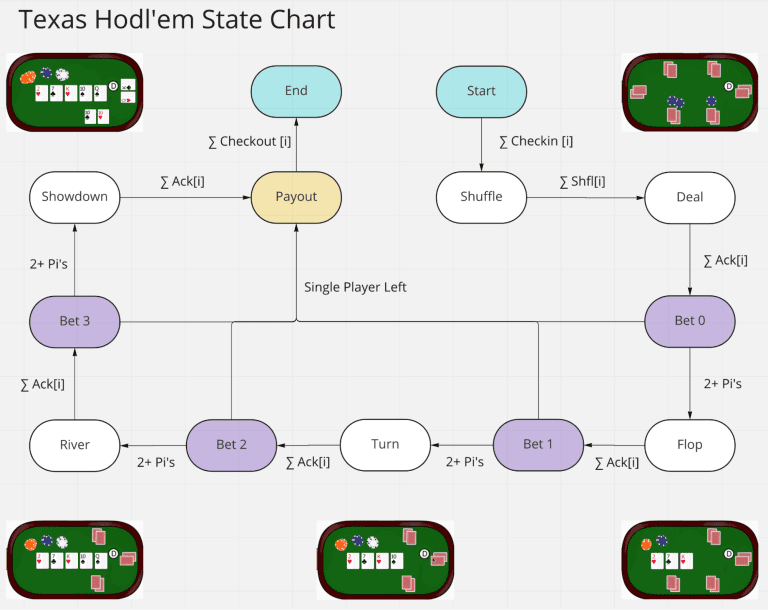
This articles refers our starting points for the implementation of the poker protocols, and outlines some of the key aspects
How to Design a Secure Poker Protocol: An In-depth Explanation
In the world of online poker, ensuring fairness and security is of paramount importance. Dr. Mario Larangeira, an expert on the field, shed light on how a secure poker protocol is created, with a focus on the technical intricacies that underpin it. His insights are centered on the Kaleidoscope protocol, a blockchain-based solution poised to redefine online card games.
Creating a Secure Poker Protocol
To create a secure poker protocol, one must first address the challenges posed by the digital realm. Traditional poker involves physical cards, where players can see each other’s actions and cards. In the online world, players are dispersed, making it challenging to maintain trust and fairness. This is where protocols like Kaleidoscope come into play.
Kaleidoscope employs a robust encryption system, allowing each player to encrypt their cards. This means that even though players can’t see each other’s cards, they can still participate in the game without revealing their strategies. The protocol also involves shuffling the cards and verifying their correctness, all while maintaining the utmost security.
Key Aspects of a Secure Poker Protocol
One of the key elements of a secure poker protocol is simulation-based security. Unlike traditional online poker platforms that require trust in a third-party intermediary, Kaleidoscope relies on cryptographic proofs to ensure fairness and security. This eliminates the need for players to trust an external entity, enhancing the overall integrity of the game.
Furthermore, the protocol incorporates penalties for cheating attempts, discouraging malicious behavior. Players who attempt to disrupt the game will incur financial penalties, providing a strong deterrent against unfair play.
In conclusion, a secure poker protocol like Kaleidoscope combines encryption, shuffling, cryptographic proofs, and penalties to ensure fairness and security in online card games. With these technical details in place, players can enjoy the thrill of poker without worrying about the integrity of the game. It’s a glimpse into the future of online card gaming, where trust is placed in mathematics and cryptography rather than intermediaries.
The Future of Online Poker: Secure and Transparent Gaming
Online poker has come a long way, but trust issues have always lingered in the background. Enter the Kaleidoscope protocol, a game-changing development led by Bernardo David in the Cardano community. This innovative protocol aims to transform the online poker experience by addressing trust and security concerns head-on.
In the world of online poker, players often have to blindly trust digital casinos. They don’t know who’s running these platforms or if there’s any cheating going on. Kaleidoscope is here to change that. It introduces a comprehensive security framework, making online poker not just safe but provably secure. This means that every aspect of the protocol aligns with stringent security standards. The protocol also ensures that rewards are guaranteed, cheaters are penalized, and cryptocurrencies are used to make it all work seamlessly. Kaleidoscope is not just about privacy; it’s about making online poker fair and transparent. It’s a significant step forward in providing players with a trustworthy gaming experience, free from doubts or uncertainties.
Our Journey Towards Secure Poker Protocols
In our ongoing pursuit to implement a cryptographically secure Texas Hold’em protocol, we embarked on this journey, drawing inspiration from the Kaleidoscope paper. We commenced our implementation journey by tackling the most challenging aspects of the protocol.
Exploring the Kaleidoscope Protocol for Online Poker
In our journey to implement the Kaleidoscope protocol for online poker, we embarked on a comprehensive exploration of this innovative solution. The protocol addresses the fundamental challenges of fairness and security in online poker, emphasizing key elements such as proof of winning, prevention of cheating, and proper rewards for winners. It introduced the concept of collateral, where players deposited both money and collateral coins to ensure fair gameplay.
To facilitate secure interactions among players, Kaleidoscope leveraged cryptographic techniques to create and share public keys. The protocol defined various actions within the game, such as fold, call, raise, and showdown, while also addressing recovery scenarios and handling pot distribution. In terms of implementation, there was a discussion of potential improvements, including the use of WebAssembly for cross-platform compatibility and the conversion of Haskell code to Rust. Overall, our journey into implementing the Kaleidoscope protocol promised to revolutionize the online poker experience, making it both secure and efficient.
In the Kaleidoscope protocol implementation discussion, the participants emphasized the need for a blockchain as a neutral reference point when parties agreed on a state or transactions. They highlighted the importance of checkpoints, where all parties signed off on a state, and how the blockchain seamlessly handled transactions if a party lost connection. Additionally, they discussed the distinction between off-chain protocol and on-chain functionality, clarifying that the former managed client communication, while the latter provided a higher-level view of intended actions. The conversation delved into the use of simulators and existing signature schemes, such as Cardano’s, to enhance security. Methods for managing seats at tables in a fair manner, involving NFTs and smart contracts, were explored. Finally, the concept of the “in-hand” state was introduced as a way to simulate interactions among players in a game, culminating in a collaborative whiteboard tool to visually represent these ideas. This insightful dialogue formed the foundation for implementing the Kaleidoscope protocol.
In the third part of our journey to implement the Kaleidoscope protocol, our team engaged in a collaborative meeting focused on refining the project’s intricacies. Participants exchanged ideas about software diagrams, procedures, and protocol implementations. Notably, they discussed the use of ElGamal encryption for card decryption, emphasizing privacy and security. This discussion highlighted the project’s complexity, the division of tasks, and the importance of visualizing concepts—a crucial step in bringing the Kaleidoscope protocol to life.
Fast forward to the present day, where we have made significant progress in implementing the Kaleidoscope protocol for online poker. What began as a discussion last year has now evolved into a tangible reality. Several key components of the protocol are complete, promising a secure and transparent online poker experience that sets new standards in the world of online gaming.